ADA MED SUPPLY LIMITED
Phone:+86 13383897707
Tel:+86-0379-65160607
Email:adaanatomy@adaanatomy.com


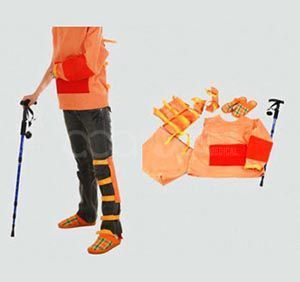
The BIX-H240 is a wearable hemiplegia simulation suit, not a manikin: a learner puts it on, picks up a crutch and performs care tasks under left- or right-sided restriction. The product page lists a reference price of US $353.52 before freight, three foot-length sizes and a washable outer material.
Quick answer. Buy the H240 if your curriculum needs learners to feel hemiplegic transfer, dressing and gait before they care for a real stroke patient. Do not buy it as a replacement for a full-body nursing manikin: it has no airway, no vascular access and no programmable vital signs.
| Item | Detail on the product page | Teaching consequence |
|---|---|---|
| Model | BIX-H240 elderly hemiplegia nursing training suit | Worn by a learner, not a patient simulator |
| Restriction | Left-right hemiparalysis can be experienced | Two learners can swap sides in one session |
| Joints | Stiffened by a restriction device; rubber band tightness adjustable | Spasticity-like resistance can be graded |
| Sizes | Type 1 21.5–23.5 cm, Type 2 24–26 cm, Type 3 26–28 cm | Sizing is by foot length, not body height |
| Colours | Light blue, grey, yellow | Colour-coding helps kit allocation |
| Mobility aid | Crutch use is built into the exercise | Gait and balance become part of the drill |
| Price | US $353.52 reference, before freight | Budget per suit, not per cohort |
| Certification | ISO 9001, ISO 14001, ISO 45001, CE | Meets common tender documentation |
The H240 reproduces three things that a lecture cannot. First, one side of the body behaves as a hemiparetic side, so the learner has to plan every transfer around a limb that does not cooperate. Second, the joints are held stiff by a restriction device, and the rubber band tension is adjustable, which lets a tutor move a learner from mild resistance to a much tighter pattern between sessions. Third, the shoes are built for elderly and disabled users, with an anti-skid sole, so the gait exercise does not turn into a slip exercise.
Those three elements map onto the parts of stroke rehabilitation that consume the most nursing time: positioning, transfer, dressing and walking with an aid. The American Heart Association guideline on adult stroke rehabilitation and recovery treats task-specific, repetitive practice as a core organising principle of rehabilitation, which is exactly the behaviour this suit forces the learner to rehearse [1].
A manikin lets a learner practise a procedure. A suit lets a learner experience the consequence of poor positioning. When a student wearing the H240 tries to dress a peer, the hemiplegic arm is the problem, and the solution — dress the affected side first, support the affected limb, allow more time — becomes obvious rather than memorised.
The suit also exposes a clinical subtlety that is hard to teach from a slide: unawareness of the deficit. Some stroke patients do not recognise their own hemiplegia, which raises fall risk and changes how nurses cue movement. A learner who has worn the suit can feel how strongly the body wants to ignore the restricted side, and that experience makes the nursing literature on anosognosia for hemiplegia easier to absorb [2].
For programmes that teach comprehensive geriatric assessment, the suit also fits naturally into a falls-and-function station: the learner assesses transfer safety while wearing it, then repeats the assessment without it and compares the two scores [3].
The three types are defined by foot length, not by height or chest size. Type 1 covers 21.5–23.5 cm, Type 2 covers 24–26 cm, and Type 3 covers 26–28 cm. In practice that means one suit cannot serve a mixed cohort of male and female students, because a foot that is too long will distort the gait and a suit that is too short will pull at the ankle.
A practical rule for a 30-student cohort is to buy the middle size in the greatest number and add one small and one large suit for outliers. Because the suit is worn over clothing and washed between users, order at least one spare set of the restraint straps with the first order; the rubber band is the part that takes the load.
Before you fix the size mix, email adaanatomy@adaanatomy.com with the cohort's foot-length range and ask for a per-size quotation including spare straps.
| Field | Value |
|---|---|
| Product number | BIX-H240 |
| Category | Nursing skill models, medical series |
| Type | Wearable hemiplegia simulation suit |
| Sizes | 21.5–23.5 cm, 24–26 cm, 26–28 cm foot length |
| Colours | Light blue, grey, yellow |
| Material | Washable, fine-grain outer material |
| Reference price | US $353.52 before freight |
| Certification | ISO 9001, ISO 14001, ISO 45001, CE |
Q1. Is the H240 a manikin or a suit? It is a suit worn by a learner. The learner experiences the restriction; there is no patient body to nurse.
Q2. Can the level of stiffness be adjusted? Yes. The page states the joints are stiffened by a restriction device and the rubber band tightness can be adjusted.
Q3. Which size should a mixed cohort buy? Measure foot length. Type 1 is 21.5–23.5 cm, Type 2 is 24–26 cm and Type 3 is 26–28 cm; most mixed cohorts need more Type 2 than any other size.
Q4. Is the suit washable? Yes. The page describes a fine, washable material, which matters because the suit is worn against clothing and reused.
Q5. Does it include a crutch? The page describes crutch experience as part of the exercise but does not state that a crutch is included. Confirm with the supplier before ordering.
Q6. What is the price and lead time? The reference price is US $353.52 before freight. Lead time depends on size mix and is quoted per order.
Contact. For a size-mix quotation, spare straps or the certificate pack, email adaanatomy@adaanatomy.com. Product page: https://www.adaanatomy.com/nursing-model/elderly-hemiplegic-nursing-simulation-suit-H240 · Nursing skill models: https://www.adaanatomy.com/nursing-skill-models · All articles: https://www.adaanatomy.com/neslist.html
