ADA MED SUPPLY LIMITED
Phone:+86 13383897707
Tel:+86-0379-65160607
Email:adaanatomy@adaanatomy.com


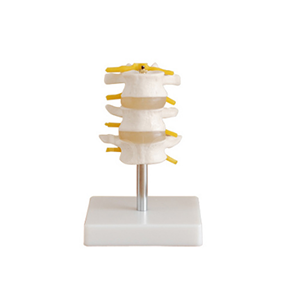
The BIX-A1016 is a three-section lumbar vertebrae model that shows the normal lumbar vertebrae, the intervertebral discs and the exiting nerve roots, mounted on a plastic seat. It is a desk-scale anatomy reference rather than a full column: no pelvis, no thoracic vertebrae and no stand taller than the bench. The reference price is US $13.26 per unit.
Quick answer. Buy the A1016 when you need one lumbar segment per bench so that every student can trace a disc and its nerve root without waiting for the departmental skeleton. Do not buy it if the lesson is about sagittal balance, pelvic incidence or the whole column — those need a full spine model.
| Item | Detail on the product page | Consequence for a lab |
|---|---|---|
| Model | BIX-A1016 lumbar vertebrae, three sections | Covers L-series anatomy only |
| Structures | Lumbar vertebrae, intervertebral discs, nerve roots | Disc-root relationship can be shown in one hand |
| Mount | Plastic seat | Stands on a bench without a clamp |
| Scale | Natural size | Matches the dimensions used in anatomy handouts |
| Reference price | US $13.26 | A 24-student lab can hold 12 units for under US $160 |
| Certification | ISO 9001, ISO 14001, ISO 45001 factory | Acceptable for public tender documentation |
The value of a sectional model is that it can be taken apart while a sentence is being spoken. With the A1016, a tutor can lift one block, expose the disc, and point to the root that exits at that level. Students who have only seen a painted column tend to believe the root exits at the same height as its disc; the sectional model makes the offset physical.
The nerve roots are moulded in place, so the model also supports a simple question that separates memorisation from understanding: if this disc herniates posterolaterally, which root is compressed? The learner has to name a root that has already left the level above.
Email adaanatomy@adaanatomy.com with the number of benches and the lumbar levels in your practical sheet, and ask for a twelve-unit quotation with carton dimensions.
The purchase price is the smallest number in the calculation. A class set of twelve units costs US $159.12 at the reference price before freight. Add the labour cost of one practical session, the storage tray and the replacement of one dropped unit every two years, and the annual cost per student remains lower than printing a colour handout for the same cohort.
The model has no consumables, no batteries and no electronic parts, which is why it survives in a shared teaching store where powered trainers do not.
| Field | Value |
|---|---|
| Product number | BIX-A1016 |
| Category | Skeleton series, spine models |
| Sections | Three |
| Structures | Lumbar vertebrae, intervertebral discs, nerve roots |
| Mount | Plastic seat |
| Reference price | US $13.26 per unit, before freight |
| Certification | ISO 9001, ISO 14001, ISO 45001 |
Q1. Is the A1016 a full spine? No. It is a three-section lumbar model. Cervical and thoracic levels are not included.
Q2. Can students practise palpation on it? Only bony landmark identification. There is no soft tissue, so tissue texture and tenderness cannot be assessed.
Q3. Is it natural size? The product page describes it as a natural large lumbar vertebra model, so dimensions follow normal lumbar anatomy rather than an enlarged teaching scale.
Q4. What is the reference price? US $13.26 per unit before freight. Ask for a volume price at twelve units, because the page does not publish a tier.
Q5. Does it include a stand? It is placed on a plastic seat. There is no tall display stand, so it sits at bench height.
Q6. How should it be cleaned? Ask the supplier for the cleaning instruction that matches the moulded plastic. The page does not specify a disinfectant, and alcohol on some moulded finishes dulls the surface.
Contact. For a twelve-unit quotation, the section-count confirmation or the carton list, email adaanatomy@adaanatomy.com. Product page: https://www.adaanatomy.com/skeleton/normal-lumbar-vertebrae-combination-three-sections--A1016 · Skeleton series: https://www.adaanatomy.com/skeleton · All articles: https://www.adaanatomy.com/neslist.html
