ADA MED SUPPLY LIMITED
Phone:+86 13383897707
Tel:+86-0379-65160607
Email:adaanatomy@adaanatomy.com


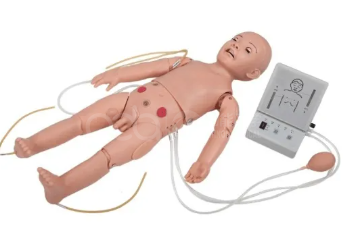
The BIX-FT432 is a one-year-old child care simulator that carries airway, vascular, urinary, bone-marrow and CPR functions on one body. The product page lists a reference price of US $1,355.18 before freight, and states that the battery and power supply are universal.
Quick answer. Buy the FT432 if you teach paediatric assessment and want one body that accepts intubation, IV access, bone-marrow aspiration, catheterisation and electronic CPR in a single scenario. Do not buy it if you only need a CPR manikin or a neonatal model — you would pay for functions your course never uses.
| Function group | What the product page lists | Drill it supports |
|---|---|---|
| Airway | Mouth, nose, tongue, gums, pharynx, larynx, oesophagus, epiglottis, trachea, tracheal rings | Orotracheal intubation, suction, oxygen |
| Access | Arm vein, femoral vein, dorsum of foot vein; deltoid, vastus lateralis, lateral thigh | Venepuncture, infusion, intramuscular and subcutaneous injection |
| Bone marrow | Tibia, surface landmark, simulated marrow outflow | Paediatric marrow aspiration |
| Gastric | Gastric tube, lavage, decompression, abdominal auscultation | Tube position checks and feeding |
| Urinary and bowel | Replaceable male and female perineum; catheterisation, enema, colostomy and cystostomy care | Basic paediatric nursing |
| CPR | Electronic monitoring of rate, volume, compression count, rate and depth | Quality-scored resuscitation practice |
| Monitoring | Auscultation of heart, breath and bowel sounds; defibrillation and pacing; ECG | Scenario-based deterioration drills |
| Price | US $1,355.18 reference, before freight | Capital purchase, not consumable |
Most paediatric labs own a torso for CPR, an arm for cannulation and a doll for catheterisation. Each trainer teaches its own skill, but none of them teaches the handover between skills — the moment when a learner has secured an airway and must then decide whether to place a gastric tube or obtain access first.
The FT432 closes that gap because the functions share one anatomy. A learner who has just intubated the child can auscultate the chest, pass a gastric tube and confirm placement by auscultating the abdomen, then move to the arm for access without changing manikins. The product page also notes that the pupils are normal but can be dilated for contrast observation, and that tracheotomy care is supported, which extends the same body into a deteriorating-airway scenario.
The World Health Organization's Integrated Management of Childhood Illness chart booklet organises paediatric assessment around general danger signs before a complaint-by-complaint examination. A simulator that accepts airway, breathing, circulation and feeding interventions on one body lets a tutor run that sequence in the intended order rather than as separate skills stations [1].
The electronic CPR feedback is the part that changes behaviour fastest: a learner who can see compression depth and ventilation volume on a display stops arguing about technique and starts correcting it. A systematic review of simulation-based learning found measurable gains in clinical decision-making when sessions were structured and debriefed rather than run as free practice, which is why the last four minutes are not optional [2].
Send the list of consumables you expect to replace each term to adaanatomy@adaanatomy.com and ask for them to be quoted as separate line items, not bundled into the unit price.
| Field | Value |
|---|---|
| Product number | BIX-FT432 |
| Category | Paediatrics and gynaecology models |
| Subject | One-year-old child care simulator |
| Airway | Full upper and lower airway anatomy for intubation and suction |
| Access sites | Arm, femoral, dorsum of foot; deltoid, vastus lateralis, lateral thigh |
| Added functions | Marrow aspiration, gastric tube, catheterisation, enema, colostomy care |
| Electronics | CPR feedback, auscultation, defibrillation and pacing, ECG |
| Power | Universal battery and power supply |
| Reference price | US $1,355.18 before freight |
| Certification | ISO 9001, ISO 14001, ISO 45001, CE |
Q1. Is the FT432 a full-body simulator? Yes. It is a one-year-old child body with head, torso and limbs, not a partial task trainer.
Q2. Can it be used with our existing defibrillator? The page states it can be used with self-prepared real defibrillation and pacing devices of different manufacturers. Confirm compatibility with your model before purchase.
Q3. Does it record CPR quality? Yes. It electronically monitors blowing frequency, blowing volume, compression count, compression rate and compression depth.
Q4. Are male and female catheterisation both possible? Yes. The perineum can be replaced for male or female catheterisation.
Q5. Is bone-marrow aspiration simulated with fluid? Yes. The tibia is the stated site, with a surface landmark and simulated marrow outflow.
Q6. What does it cost? The reference price is US $1,355.18 before freight. Ask for a quotation that includes spare access skins and perineum inserts.
Contact. For a quotation with spare skins, perineum inserts and the certificate pack, email adaanatomy@adaanatomy.com. Product page: https://www.adaanatomy.com/pediatric-gynecological/full-featured-one-year-old-child-senior-care-simulator-with-stethoscope-FT432 · Paediatrics and gynaecology models: https://www.adaanatomy.com/pediatric-gynecological-models · All articles: https://www.adaanatomy.com/neslist.html
