ADA MED SUPPLY LIMITED
Phone:+86 13383897707
Tel:+86-0379-65160607
Email:adaanatomy@adaanatomy.com


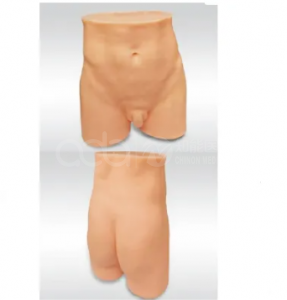

Quick answer. The BIX-ZC-III is a soft-skin model of an adult male lower body carrying 20 commonly used hip and lumbar acupoints, including Huantiao (GB30), Changqiang (GV1), Shenque (CV8), Guanyuan (CV4), Daimai (GB26) and Yaoyangguan (GV3). The point marks are only visible under the supplied LED torch, so students must locate them by palpation and surface landmarks before they can check their answer.
Acupuncture teaching has a quiet measurement problem: students can name points on a chart long before they can find them on a body. A model with printed dots solves the vocabulary test and fails the palpation test. The BIX-ZC-III is built the other way round — the marks are hidden until you light them.
| Item | Specification | Teaching purpose |
|---|---|---|
| Body region | Adult male lower body, hip and buttock | Landmark practice in the region where points are hardest to see |
| Marked acupoints | 20, including Huantiao, Changqiang, Huiyang, Shenque, Guanyuan, Yuanhai, Tianshu, Daheng, Chengfu, Weidao, Yaoyangguan, Dachangshu, Ciliao | Point location and depth orientation |
| Skin | Soft PVC with human-like texture and feel | Needle handling and palpation realism |
| Accessories | 1 professional LED torch, 4 AA batteries | Hidden-mark verification without printing |
| Certification | ISO 9001, ISO 14001, ISO 45001 factory | Procurement and tender documentation |
Visible points invite a matching exercise: the student compares a dot on the model with a dot on a chart and calls it learning. Hidden points force retrieval instead. The student must first find the anatomical landmark — the greater trochanter, the posterior superior iliac spine, the sacral hiatus — then reason to the point, then verify with light.
That sequence mirrors what happens in clinic, where the only feedback is the patient's response. Reviews of acupuncture teaching consistently report that practical, hands-on training with structured feedback is the weakest link in otherwise strong curricula, and that simulated practice is where the gap is closed [1][3]. The torch is a cheap simulator of clinical feedback: it does not tell the student where the point is, it only confirms or denies an answer the student has already committed to.
Virtual systems have been used to teach moxibustion technique where live practice is limited, and training instruments for warming-needle moxibustion have been developed specifically to give students repeatable practice before they work on patients [1][2]. A physical model does the same job for point location, at a fraction of the cost of a simulation suite.
Treat the model as a landmark trainer, and be explicit with students about that boundary. A model that is oversold as a clinical simulator creates false confidence.
Quotation. Current price, packing data and lead time for the BIX-ZC-III are available from adaanatomy@adaanatomy.com; include your annual student intake so the quote matches your course size.
Q1. How many acupoints are marked on the BIX-ZC-III? Twenty commonly used points on the hip, buttock and lower abdomen, including Huantiao, Changqiang, Huiyang, Shenque, Guanyuan, Daimai, Yaoyangguan, Dachangshu and Ciliao.
Q2. Are the acupoint marks always visible? No. They are invisible in normal light and become visible only under the supplied LED torch, which is the point of the design: students locate first, verify second.
Q3. What is included in the box? One acupuncture buttock training model, one professional LED torch and four AA batteries.
Q4. Can students insert real needles? The skin is soft PVC with a human-like feel and is intended for palpation and handling practice. Confirm needle use and cleaning routine with the supplier for your own protocol.
Q5. Is it suitable for moxibustion teaching as well as needling? Yes. The lower-body posture supports moxibustion positioning practice over lumbar and abdominal points, which is why the model is also listed as a moxibustion training model.
Q6. How should it be stored and cleaned? Store covered, away from direct sun and heat. Wipe with a mild soap solution and dry fully; avoid alcohol on the marked skin if you want the point coating to last.
Product page: BIX-ZC-III Acupuncture Buttock Model: Teaching 20 Hidden Hip Acupoints — specification, packing data and a quotation request form.
For a quotation on the BIX-ZC-III, or to ask about spare torches and skin care, write to adaanatomy@adaanatomy.com.
