ADA MED SUPPLY LIMITED
Phone:+86 13383897707
Tel:+86-0379-65160607
Email:adaanatomy@adaanatomy.com


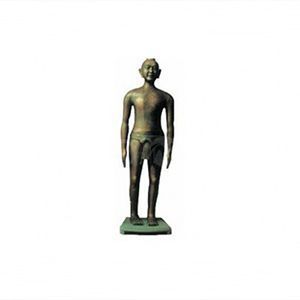

The bronze man is the oldest teaching device in acupuncture, and it survives because it solves one problem no chart solves: the student has to find the point on a body, at body scale, in three dimensions. The BIX-Y1001 is a modern version — 168 cm, fiberglass, with the 14 primary channels, 361 acupoints and 48 extraordinary points marked on the right side and a subcutaneous view on the left.
At a reference price of $530.34, it sits in the "department purchase" bracket rather than the "student purchase" bracket. This review sets out what the model does well, where it misleads, and who should not buy it.
| Surface | Content | Teaching use |
|---|---|---|
| Right side | 14 primary channels, 361 acupoints, 48 extraordinary points | Point naming, channel tracing, point sequencing |
| Right side | CUN markers | Proportional distance measurement between points |
| Left side | Subcutaneous view: nerves, arteries, veins, blood vessels, muscle | Explains why a point sits where it does |
| Left side | Upper and lower extremity extra points | Covers points outside the primary channels |
| Whole model | Fiberglass, 168 cm | Full-scale demonstration and examination practice |
The CUN markers are the detail that changes classroom behaviour. Without them, students learn a point as "three fingers below the knee"; with them, the same point becomes a measured proportion of the limb, which is how point location is specified in the international standard [1]. A model that prints the measurement can be used to test location rather than only to illustrate it.
Most acupuncture models stop at the channel map. The left side of the Y1001 shows what lies under the point: nerve, artery, vein and muscle. That matters for two reasons.
First, safety. A student who can see that a point sits over a vessel understands why depth and angle are restricted, and why some points are avoided in certain patients. Second, retention. Anatomy learned as a relationship between structures is retained better than a list of point names, and physical models outperform screens and textbooks for exactly this kind of spatial learning [2].
Buy the Y1001 if the department teaches point location to groups, runs practical examinations, or needs one full-scale reference object that both students and patients can read. The combination of right-side channel mapping and left-side subcutaneous anatomy covers two different lessons on one body, which is unusual at this price.
Do not buy it if the course is needling-technique focused, if storage is limited to a cupboard, or if the syllabus covers only a small set of points that a 50 cm desk model would serve.
Quotation and specification. Current pricing and delivery for the BIX-Y1001 are available from adaanatomy@adaanatomy.com.
Q1. How tall is the BIX-Y1001? 168 cm, approximately life-size for an adult.
Q2. What material is it made from? Fiberglass, described by the manufacturer as non-toxic, unbroken, undeformed and easy to preserve and transport.
Q3. How many points are marked? 361 acupoints along the 14 primary channels plus 48 extraordinary points, with additional extra points on the extremities.
Q4. What is on the left side of the model? A subcutaneous view showing neural distribution, arteries, veins, blood vessels and muscular structures.
Q5. What are the CUN markers for? They mark proportional distances used to locate points consistently, rather than by approximate finger widths.
Q6. Is it suitable for needling practice? No. It is a location and anatomy model; needling depth and angle require a needling pad or a dedicated practice model.
Product page: BIX-Y1001 Review: What a 168 cm Bronze Man Model Actually Teaches — specification, packing data and a quotation request form.
For a quotation on the BIX-Y1001, including labelling language and stand options, write to adaanatomy@adaanatomy.com with your course level and storage constraints.
