ADA MED SUPPLY LIMITED
Phone:+86 13383897707
Tel:+86-0379-65160607
Email:adaanatomy@adaanatomy.com


Article tag: Half Body CPR Training Manikin BIX/CPR100A CPR100A
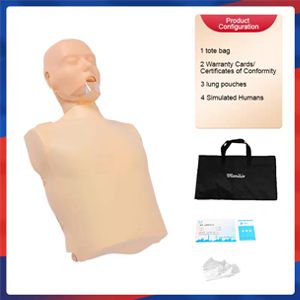
Model | BIX/CPR100A — Half Body CPR Training Manikin (AHA 2020 Compliant) |
Summary | Half-body CPR manikin: tri-color LED feedback for depth (5-6 cm) and rate (100-120/min), 30:2 ratio, AHA 2020. For schools, hospitals, training centers. (152 chars) |
Price | $176 per unit |
MOQ | 10 units (samples 1–2 available) |
Type | Half body (head + torso), tabletop |
Feedback | Tri-color LED: depth zones (<5 cm yellow / 5–6 cm green / >6 cm red); rate tiers (<60 / 60–80 / 80–100 / 100–120/min) |
Ventilation Feedback | Dynamic LED for inhalation volume (500–1000 ml) |
Carotid Pulse | Simulated spontaneous pulse |
Cycle Ratio | 30:2 (compression : ventilation) |
Out-of-hospital cardiac arrest remains one of the most lethal emergencies in modern medicine: in the United States alone, roughly 350,000+ occur annually, and survival depends heavily on the quality of CPR delivered before advanced care arrives (Panchal et al., 2020). The 2020 AHA guidelines define the adult quality targets:
Metric | AHA 2020 Target |
Compression depth | 5–6 cm |
Compression rate | 100–120/min |
Compression fraction (CCF) | >80% (minimize interruptions) |
Full chest recoil | Between compressions |
Ventilation | Visible chest rise, ~500–600 ml in adult |
But here is the training problem: a trainee cannot see inside the chest. Compressing at 4.2 cm feels identical to 5.2 cm; pacing at 90/min feels the same as 115/min. Without feedback, common errors (too shallow, too slow, leaning, over-ventilation) are silently practiced — and skill errors that are practiced are errors that are retained (Smith et al., 2008).
The CPR100A's tri-color LED system converts invisible performance into visible cues:
LED Color | Compression Depth | Compression Rate |
Yellow | <5 cm (too shallow) | <60/min (too slow) |
Green (single) | 5–6 cm (correct) | 60–80/min |
Green (double) | 5–6 cm (correct) | 100–120/min (ideal) |
Red | >6 cm (too deep) | — |
This design is directly supported by the evidence:
● Real-time feedback during simulated cardiac arrest is
associated with higher CPR quality
delivered by trained providers (Gilfoyle et al., 2023).
● The AHA consensus statement identifies compression depth, rate, and fraction as core quality components, and supports the use of feedback devices during training (Meaney et al., 2013).
● Technology-enhanced simulation produces large skill gains — effect sizes of 1.09–1.20 for time-based and procedural skills across 35,226 learners (Cook et al., 2011).
The result: a passive practice session becomes an active skill-correction drill, at a price point that lets every student practice, not just watch.
1. Compress into the 5–6 cm green zone while watching the LED.
2. Hold 100–120/min for 2 minutes; note rate-tier LED changes.
3. Correct one error at a time (depth first, then rate).
1. Practice ventilation within the 500–1000 ml LED range.
2. Run 30:2 cycles; verify ratio rhythm across 5 cycles.
1. Continuous CPR for 2 minutes on the half-body unit.
2. Pass standard: depth and rate in green zones, full recoil, correct 30:2, no interruptions.
1. Combine compression, ventilation, and simulated carotid pulse checks into one scenario.
2. Debrief using LED observations; schedule the next refresher.
Refresher note: CPR skills decay within months — BLS passing rates in nurses fell from 63% at 3 months to 58% at 12 months (Smith et al., 2008). The AHA recommends more frequent, shorter practice sessions over single annual courses (Bhanji et al., 2015).
Metric | Standard |
Compression depth | In green 5–6 cm zone (AHA 2020) |
Compression rate | 100–120/min |
Ventilation | Within 500–1000 ml LED range |
30:2 rhythm | Correct across 5 cycles |
Score | ≥90% in two-minute test |
Item | Frequency | Notes |
Manikin surface | After each class | Wipe with mild soap and damp cloth |
Lung bags & face masks | Per use | Replace face shield; inspect lung bags |
LED sensor check | Monthly | Test indicators and battery contacts |
Storage | Always | Cool, dry; avoid direct sunlight on TPE |
With proper care, the compression mechanism is rated for ~500,000 cycles — 20+ years at typical classroom usage.
Q1: What is the difference between CPR100A and CPR100B? A: CPR100A is the electronic version with tri-color LED feedback for depth and rate — trainees see their performance in real time. CPR100B has mechanical clicker feedback only (no electronics) — a lower-cost option for budget programs that can do without digital cues.
Q2: Does it meet AHA standards? A: Yes — the depth zone (5–6 cm), rate target (100–120/min), and 30:2 ratio align with the AHA 2020 Adult BLS guidelines (Panchal et al., 2020). The LED system trains exactly the metrics the guidelines identify as critical.
Q3: How does the LED feedback work? A: An internal compression sensor detects depth and rate and drives the LEDs in real time. Battery-powered (standard AA, not included) — fully portable for off-site training.
Q4: Can it be used for AED training? A: It is a CPR trainer; it has no AED simulation. For combined CPR + AED stations, pair it with a standalone AED trainer, or choose a higher-tier model with defibrillation simulation.
Q5: Is it suitable for pediatric CPR? A: No — it trains adult CPR standards (5–6 cm depth). Pediatric CPR requires different depth parameters (about 4 cm for children, ~4 cm/1.5 in for infants) — use dedicated pediatric or infant manikins.
Q6: What is the MOQ and delivery time? A: MOQ is 10 units (samples 1–2 available). Air freight: 7–10 business days; sea freight: 30–45 days. Email adaanatomy@adaanatomy.com for a quote.
Part 3: Adult Basic and Advanced Life Support: 2020 AHA Guidelines for CPR and ECC — Panchal et al. (2020), Circulation 142(16 Suppl 2):S366–S468
Cardiopulmonary Resuscitation Quality: Improving Cardiac Resuscitation Outcomes — AHA Consensus Statement — Meaney et al. (2013), Circulation 128(4):417–435
Association of Real-Time Feedback and Cardiopulmonary-Resuscitation Quality Delivered by Ambulance Personnel — Gilfoyle et al. (2023), J Am Heart Assoc 12(20):e029457
Technology-Enhanced Simulation for Health Professions Education: A Systematic Review and Meta-analysis — Cook et al. (2011), JAMA 306(9):978–988
Evaluation of Staff's Retention of ACLS and BLS Skills — Smith et al. (2008), Resuscitation 78(1):59–65
Part 14: Education: 2015 AHA Guidelines Update for CPR and ECC — Bhanji et al. (2015), Circulation 132(18 Suppl 2):S561–S573
