ADA MED SUPPLY LIMITED
Phone:+86 13383897707
Tel:+86-0379-65160607
Email:adaanatomy@adaanatomy.com


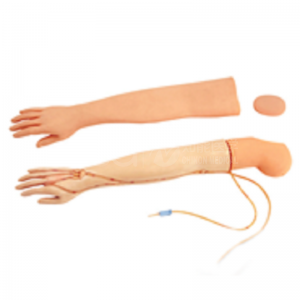
Model | BIX-HS3 — Full Function Arm Venipuncture Injection Model |
Summary | Full-arm trainer for injection, blood transfusion, and blood draw plus deltoid injection. Realistic needle penetration feel, blood flashback confirms correct insertion, puncture-resistant veins/skin with no leaks, replaceable vein and skin. 69×20×12 cm, 3 kg. (157 chars) |
Procedures | IV injection, transfusion, blood draw, deltoid IM |
Key Feature | Blood flashback + needle penetration feel |
Replaceable | Vein and skin sets |
Package | 69 × 20 × 12 cm, 3 kg |
Application | Nursing schools, phlebotomy programs, clinical skills labs |
Venipuncture combines the highest procedure volume in healthcare with the most unforgiving learning curve: a failed stick hurts the patient, wastes time, and damages the student's confidence — and clinical opportunities to practice are shrinking.
The training problem has three parts:
Patient tolerance:
1. repeated unsuccessful sticks are painful and ethically problematic.
Opportunity scarcity:
2. clinical rotations offer limited, unpredictable venipuncture chances.
Feedback absence:
3. without seeing the needle enter the vein (flashback), students cannot verify their technique.
Simulation addresses all three. A systematic review by Issenberg et al. (2005) established that simulation-based skill training with feedback and repetitive practice — exactly what a venipuncture arm provides — is among the most effective forms of medical education. Students can practice the procedure 20 times in an afternoon, with the flashback signal confirming each success.
Feature | Teaching Value |
Injection, transfusion, blood draw | Three procedures on one model — the full IV skill set |
Deltoid muscle injection | Adds IM injection practice without a second model |
Obvious needle penetration feel | Students learn the tactile "pop" of venous entry — the sensation that cannot be taught from a textbook |
Blood flashback on correct insertion | Objective confirmation of successful venipuncture — the same feedback a real blood draw provides |
Repeatable puncture without leaks | High-volume practice: one model supports dozens of students per session |
Replaceable vein and skin | Extends model life; consumable cost is predictable |
The flashback feature is the critical training element. In clinical practice, flashback is the first confirmation that the needle is in the vein — before the tourniquet is released and blood is drawn. Students who practice with a model that produces flashback learn to correlate the tactile sensation of entry with the visual confirmation.
Objective: Complete a supervised IV insertion with flashback confirmation.
Phase | Time | Trainee Action |
Landmark identification | 3 min | Palpate and select a vein; note the antecubital fossa options |
Tourniquet application | 2 min | Apply above the site, verify vein distension |
Insertion | 8 min | 15–30° angle, bevel up, observe flashback |
Confirmation | 3 min | Release tourniquet, verify blood return, anchor needle |
Securing | 4 min | Tape/secure, simulate line connection |
Repetition | 10 min | Two additional insertions on different veins |
1. Select vein, apply tourniquet.
2. Insert needle at 15° with flashback confirmation.
3. Attach vacuum tube, observe filling.
4. Release tourniquet, remove needle, apply pressure —
the compression step is where most student errors occur; teach it deliberately.
1. Locate the deltoid muscle landmarks (acromion, deltoid tuberosity).
2. Clean the site; insert at 90° angle.
3. Aspirate, inject slowly, withdraw, apply pressure.
Class Size | Units | Students per Unit | Rotation | Total Time |
6–10 | 2 | 3–5 : 1 | 20-min stations | 90 min |
10–20 | 4 | 3–5 : 1 | 3 stations (IV/draw/IM) | 90 min |
20–30 | 6 | 4–5 : 1 | 3 parallel stations | 90 min |
Consumable economics: one HS3 arm supports 50+ puncture attempts per session before vein replacement. A 20-student cohort completing 5 insertions each = 100 punctures — roughly two sessions per vein set. Budget 2 replacement vein/skin sets per unit per semester.
Station | Time | Task | Pass Criteria |
1. IV insertion | 10 min | Cannulate with flashback confirmation | Flashback observed, needle secured |
2. Blood draw | 10 min | Vacuum tube collection | Tube fills, pressure applied after removal |
3. Deltoid IM | 8 min | IM injection with landmarks | Correct site, 90° angle, aspiration |
4. Tourniquet + site selection | 8 min | Select best vein, apply tourniquet | Vein selection justified |
Interval | Action |
After each session | Flush veins with clean water; dry skin surface |
Weekly | Check vein patency — insert flush fluid, confirm flow |
Monthly | Inspect skin for tears at puncture sites |
Per vein set | Replace when leaking or non-patent (per manufacturer guidance) |
Important: Use only water or saline for flushing — oils degrade the vein tubing. Store the arm flat to prevent kinking. For replacement vein/skin sets: adaanatomy@adaanatomy.com..
Q1: How many times can the veins be punctured before replacement? A: The veins tolerate repeated puncture without leaking — typically 50+ attempts per set depending on needle gauge and technique. Replace when leakage or flow obstruction appears.
Q2: What needle gauges are appropriate? A: Standard training needles (21–23G) are recommended. Larger gauges (18G) accelerate vein wear. The model's flashback works with butterfly needles and standard IV catheters.
Q3: Is the model suitable for phlebotomy certification? A: Yes — blood draw with vacuum tube filling is supported, and the flashback confirmation mirrors clinical practice. Combined with the deltoid IM module, it covers common phlebotomy and injection OSCE stations.
Q4: What is the difference between HS3 and HS3S? A: The HS3S adds a pump for simulated blood flow; the HS3 is the pump-free version with manual flashback. Programs prioritizing budget typically choose the HS3; programs simulating continuous flow scenarios choose the HS3S.
Q5: What replacement parts are needed? A: Replacement vein sets and skin sets — order 2 of each per unit per semester. These are the only consumables; no other parts wear under normal use.
Q6: What is the MOQ and delivery timeline? A: Standard MOQ is 10 units; sample evaluation units (1–2) available. Air freight: 7–10 business days. For nursing school deployments, email adaanatomy@adaanatomy.com. for volume pricing.
BEME Systematic Review: Simulation-Based Medical Education — Issenberg et al. (2005)
Simulation-Based Training for Intravenous Cannulation — Reznek et al. (2002)
National Healthcare Simulation Standards — INACSL (2021)
WHO Guidelines on Hand Hygiene in Health Care (Phlebotomy Section, 2009)
Simulation-Based Medical Education: An Ethical Imperative — Ziv et al. (2003)
