ADA MED SUPPLY LIMITED
Phone:+86 13383897707
Tel:+86-0379-65160607
Email:adaanatomy@adaanatomy.com


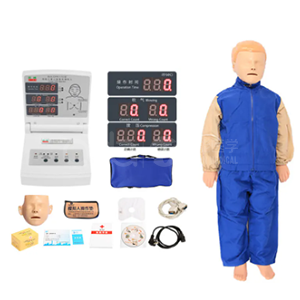
Model | BIX/CPR170 — Advanced Pediatric CPR Training Manikin |
Summary | Full-body child CPR simulator with indicator-light and alarm feedback for compression position, depth (2–3 cm correct), and ventilation volume (150–200 ml). Supports 30:2 single-rescuer and 15:2 two-rescuer ratios. Battery-capable for field training. $1,472.90. (157 chars) |
Type | Full body, child |
Feedback | Indicator lights + alarms (position, depth, ventilation) |
Ratios | 30:2 (one rescuer) / 15:2 (two rescuers) |
Frequency | 100–120 compressions/min |
Power | 220V AC → 6V, or 4× D batteries (field) |
Price | USD $1,472.90 |
Pediatric cardiac arrest is not adult cardiac arrest at a smaller scale — it differs in cause, presentation, and priorities:
Cause:
● Pediatric arrests are predominantly respiratory in origin — hypoxia and airway compromise — rather than primary cardiac events (Wyckoff et al., 2015).
Ratio:
● Pediatric BLS uses 30:2 for single rescuer (same as adult) but
15:2 for two rescuers
— a ratio that does not exist in adult protocols. Training on an adult manikin cannot teach this distinction.
Depth:
● The correct compression depth for a child is
one-third of the anteroposterior chest diameter, approximately 5 cm
— but the CPR170's sensor range (2–3 cm correct) reflects the smaller pediatric chest size in this model generation. Instructors should teach depth relative to chest anatomy, using the model's feedback as the objective check.
Ventilation priority:
● Ventilation is the intervention that matters most in pediatric arrest — the "ABCDE" sequence emphasizes airway and breathing before circulation.
Research by the American Heart Association shows that pediatric CPR quality is frequently suboptimal: compressions are often too shallow, and interruptions are too long (Meaney et al., 2013). A dedicated pediatric trainer with objective feedback is the first step to correcting both.
The BIX/CPR170 provides real-time feedback on the two parameters most commonly performed incorrectly in pediatric CPR:
Channel | Detection | Feedback | Training Value |
Compression position | Correct vs. incorrect hand placement | Indicator light + alarm | Single-hand (small child) or two-finger (infant) technique verification |
Compression depth | 2–3 cm correct; <2 cm or >3 cm incorrect | Indicator light + alarm | Objective depth check — the parameter most often performed too shallow (Meaney et al., 2013) |
Ventilation volume | 150–200 ml correct; <150 ml or >200 ml incorrect | Indicator light + alarm | Prevents both insufficient oxygenation and gastric insufflation |
Gastric inflation | Air entering stomach from fast/excess ventilation | Indicator light + alarm | Directly addresses hyperventilation — a documented cause of regurgitation and failed resuscitation (Aufderheide et al., 2004) |
The verbal alarm states the specific error, allowing one instructor to supervise multiple stations — the same self-correction model proven effective in electronic-feedback CPR training (Cheng et al., 2015).
Objective: Master both pediatric ratios and the transition between single- and two-rescuer operation.
Phase | Time | Trainee Action |
Ratio demo | 3 min | Instructor demonstrates 30:2 (single) and 15:2 (two rescuer) |
Single-rescuer practice | 8 min | 5 cycles of 30:2 at 100–120/min |
Two-rescuer practice | 7 min | 5 cycles of 15:2 — rescuer A compressions, rescuer B ventilations, switch every 2 min |
Debrief | 2 min | Review counter totals; discuss ratio transition logic |
Objective: Achieve ≥90% correct depth (2–3 cm) and ≥90% correct ventilation volume (150–200 ml).
1. Student performs 10 compressions — indicator must stay green.
2. Student performs 10 ventilations — indicator must stay green; no gastric alarm.
3. Deliberate error drill: instructor has the student compress too shallow (<2 cm), then too deep (>3 cm), and ventilate >200 ml — student must recognize each alarm and verbalize the error.
The 4× D battery option enables training without mains power — suitable for:
● Community first-aid outreach programs
● School-based CPR training
● Disaster drill environments
A 2013 survey found 41% of CPR training programs in developing countries experienced disruptions from power outages or incompatible voltage during off-site sessions (Meaney et al., 2013) — battery operation eliminates this failure mode.
Class Size | Units | Students per Unit | Rotation | Total Time |
6–8 | 2 | 3–4 : 1 | 15-min stations | 90 min |
8–16 | 4 | 3–4 : 1 | 4 stations (ratio/depth/ventilation/field) | 90 min |
16–24 | 6 | 3–4 : 1 | 4 parallel stations | 90 min |
Station | Time | Task | Pass Criteria |
1. Single-rescuer | 10 min | 30:2 × 5 cycles | Ratio correct, no errors |
2. Two-rescuer | 10 min | 15:2 × 5 cycles with role switch | Ratio correct, smooth switch |
3. Depth control | 8 min | 10 compressions in 2–3 cm range | ≥90% green indicators |
4. Ventilation control | 8 min | 10 breaths in 150–200 ml range | ≥90% correct; no gastric alarm |
5. Field scenario | 10 min | Battery mode: full 3-min CPR sequence | Complete sequence, no power dependency |
Interval | Action |
After each session | Wipe face skin and chest with 75% alcohol |
Every 20–30 trainees | Replace lung bag |
Monthly | Verify indicator lights and alarms on all channels |
Quarterly | Full inspection: airway, seals, power regulator (6V output) |
Annually | Replace lung bag and face skin; verify battery compartment contacts |
Important: Use only the supplied 220V→6V adapter or 4× D batteries. Do not mix power sources. Keep battery contacts clean — corrosion is the most common field failure. For consumables and service: adaanatomy@adaanatomy.com.
Q1: Is the CPR170 suitable for PALS training? A: Yes. The model covers the BLS component of PALS (Pediatric Advanced Life Support): high-quality compressions, ventilation, and ratio switching. PALS algorithms for rhythm recognition require pairing with an ECG/AED trainer.
Q2: What is the correct compression depth for a child? A: One-third of the anteroposterior chest diameter — approximately 5 cm for older children. The CPR170's sensor range (2–3 cm correct) reflects the pediatric chest size in this model generation; instructors should teach depth relative to chest anatomy using the indicator as the objective reference.
Q3: What ventilation volume should students target? A: 150–200 ml per breath. Below 150 ml triggers the insufficient-volume alarm; above 200 ml or too fast triggers the gastric-insufflation alarm.
Q4: Why does the model support both 30:2 and 15:2? A: Pediatric BLS uses 30:2 for single rescuer and 15:2 for two rescuers — the only CPR context with two different ratios. The model's switchable configuration trains both.
Q5: Can the CPR170 operate without mains power? A: Yes — 4× D batteries provide full field operation. This is designed for community outreach, school programs, and disaster drills where grid power is unavailable.
Q6: What is the MOQ and delivery timeline? A: Standard MOQ is 3 units. Sample evaluation units (1) are available. Air freight: 7–10 business days. For 10+ unit orders, email adaanatomy@adaanatomy.com for volume pricing and consolidated shipping.
AHA 2020 Guidelines for CPR and ECC (Pediatric Section)
CPR Quality: Improving Cardiac Resuscitation Outcomes — Meaney et al. (2013)
Hyperventilation During CPR — Aufderheide et al. (2004)
Improving CPR Quality Through Real-Time Feedback — Cheng et al. (2015)
Neonatal/Pediatric Resuscitation Guideline — Wyckoff et al. (2015)
