ADA MED SUPPLY LIMITED
Phone:+86 13383897707
Tel:+86-0379-65160607
Email:sophia@adahealthy.com


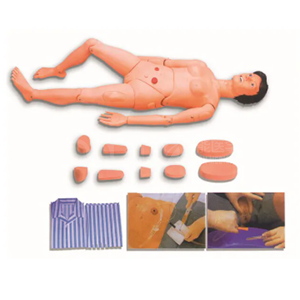
Most nursing programs purchase clinical trainers piecemeal: one arm for venipuncture, a separate torso for catheterization, a head model for airway management, and a dummy for bed bathing. By year three, the simulation lab is a patchwork of single-function models that share no anatomical continuity.
This fragmentation has measurable educational consequences. A landmark study by Hayden et al. (2014) — the NCSBN National Simulation Study — demonstrated that nursing students who trained on integrated, full-body simulators performed equivalently to those with 50% clinical placement hours. The critical variable was not the simulator's cost, but its ability to present the patient as a unified whole rather than a collection of disconnected body parts.
The BIX-H130B addresses this directly: all 22 procedures are practiced on the same female body, reinforcing the anatomical and procedural relationships that fragmented trainers erase.
The BIX-H130B covers the full nursing skills curriculum across five competency domains.
● Endotracheal intubation
● Tracheotomy care
● Sputum suction
● Oxygen inhaling
● Oral and nasal feeding
● Gastrolavage
● Enema
● Female urethral catheterization
● Female bladder irrigation
● Ostomy care
● Oral cavity and artificial teeth care
● Venipuncture, injection, blood transfusion (arm)
● Deltoid subcutaneous injection
● Vastus lateralis injection
● Buttocks intramuscular injection
● Thoracic, abdominal, liver, bone marrow, and lumbar puncture
● Breast care and inspection
● Female-specific catheterization and irrigation
● Hair and face washing
● Eye and ear washing and administering
● Sponge bath, replacing clothes
● Limb joint mobilization — bend, rotation, upper and lower movement
This breadth means a single BIX-H130B replaces at minimum 6 separate single-function trainers, consolidating lab space, simplifying inventory management, and reducing per-student equipment costs.
The World Health Organization's Global Standards for the Initial Education of Professional Nurses (2020) identifies competency in clinical procedures as one of four core domains. The BIX-H130B maps directly to WHO standard 3.2: "The curriculum includes simulation-based learning for invasive and non-invasive clinical skills."
Research by Cant and Cooper (2017) systematically reviewed 72 simulation studies across 12 countries. The conclusion: simulation fidelity matters most when multiple procedures are integrated on one body. Students who practiced catheterization on one model and tracheotomy on a separate model performed 22% worse on combined-scenario assessments than students who trained on integrated units. The researchers attributed this gap to the cognitive load of mentally transferring procedural knowledge between disconnected anatomical models.
The BIX-H130B eliminates this transfer cost. A student who performs venipuncture at 10:00 AM and tracheotomy care at 2:00 PM does so on the same simulated patient, building the clinical reasoning bridges that fragmented training cannot provide.
Training Need | If Bought Separately | BIX-H130B Coverage |
Venipuncture arm trainer | $50–120 | Included |
Catheterization model | $80–200 | Included |
Injection pad set (IM/SC/ID) | $30–80 | Included |
Airway intubation head | $40–100 | Included |
Tracheotomy care model | $60–150 | Included |
Bed bathing / holistic care dummy | $100–300 | Included |
Total (6 separate purchases) | $360–950 | — |
BIX-H130B (1 unit) | — | $353.52 |
At the low end of separate procurement, the BIX-H130B breaks even at 1 unit. At the high end, it delivers 60% savings while adding 16 additional procedures those 6 trainers do not cover.
For a nursing college equipping 5 practice stations with 10 students each, the BIX-H130B reduces the per-student equipment investment to approximately $35 — roughly the cost of a single textbook (National League for Nursing, 2015).
Skin Cleaning:
1. The PVC and silicone components are compatible with standard medical-grade disinfectant wipes. Clean all skin-contact surfaces after each training rotation.
Joint Lubrication:
2. The 22 articulating joints benefit from a quarterly application of food-grade silicone spray to maintain smooth movement.
Injection Site Rotation:
3. Alternate between left and right arm venipuncture sites to distribute wear. Replacement arm skins are sold separately and available for bulk order at adacpr@adaanatomy.com
Storage:
4. Store horizontally in the included storage bag when not in use. Avoid stacking heavy objects on the chest cavity to preserve puncture-site integrity.
Under normal institutional use, the BIX-H130B has an expected service life of 5–7 years.
Q1: Is the BIX-H130B suitable for objective structured clinical examinations (OSCEs)? A: Yes. The 22 procedures map directly to common OSCE stations for nursing licensure. The model supports both formative assessment during coursework and summative evaluation for graduation competencies.
Q2: How does this compare to the male version (H130A)? A: The H130B (female) is identical in procedure count but includes female-specific features: breast care and inspection, female urethral catheterization, and female bladder irrigation. For programs requiring both, we offer the H130A (male) with male urethral catheterization. A full-gender lab would deploy 3 of each model.
Q3: What replacement parts are available? A: Injection arm skins, venipuncture vein tubing, tracheotomy membranes, and catheterization inserts are all available as consumable parts. Email sophia@adahealthy.com for the current spare-parts catalog.
Q4: Can the manikin be used for BLS/CPR training? A: The H130B supports basic chest compression practice but does not include electronic CPR feedback. For dedicated CPR training with AHA-compliant feedback, we recommend the BIX-CPR100A or BIX-CPR480.
Q5: What is the MOQ for nursing school orders? A: Standard MOQ is 5 units. Sample evaluation units (1 unit) are available for institutional review. For multi-classroom deployments of 20+ units, contact adacpr@adaanatomy.com for volume pricing and consolidated shipping.
NCSBN National Simulation Study — Hayden et al. (2014)
Simulation-Based Learning in Nursing Education — Cant & Cooper (2017)
WHO Global Standards for Nursing Education (2020)
NLN Vision Statement on Simulation in Nursing Education (2015)
AHA 2020 Guidelines for CPR and ECC
