ADA MED SUPPLY LIMITED
Phone:+86 13383897707
Tel:+86-0379-65160607
Email:adaanatomy@adaanatomy.com


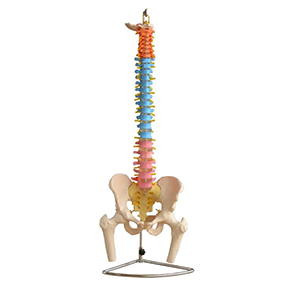
The BIX-ADA126C is a didactic vertebral column with pelvis and paired femur heads. The product page states that the model is upgraded from the XC-126 and that each spinal section is moulded in a different colour: cervical vertebrae, thoracic vertebrae, lumbar vertebrae, sacrum and coccyx. The reference price is US $57.76 before freight.
Quick answer. The ADA126C is a lecture-and-viva model. Buy it to teach regional segmentation and the sacroiliac-to-hip relationship in one object. Do not buy it for palpation practice, pathology or ligament detail — the page lists none of those, and colour coding cannot substitute for them.
| Colour-coded region | Segment it marks | What the colour still cannot teach |
|---|---|---|
| Cervical | Seven cervical vertebrae | Facet orientation and the course of the vertebral artery |
| Thoracic | Twelve thoracic vertebrae | Costal facet pairing and rib articulation |
| Lumbar | Five lumbar vertebrae | Load transfer and the direction of facet joints |
| Sacrum | Fused sacral segment | Sacral foramina and sacroiliac joint surfaces |
| Coccyx | Terminal segment | Attachments and clinical relevance in trauma |
Vertebral counts are standard anatomy, not a product claim. What the model adds is a visual boundary between regions: a student can see where cervical ends and thoracic begins without counting from a diagram.
Colour is an attention cue. An eye-tracking study of multimedia learning found that colour coding guided attention to the elements that shared a code and improved retention of those relationships [1]. In a spine model, the same mechanism applies: five colours create five mental buckets before the student knows the names.
The effect is not unconditional. A 2021 study reported a guidance-reversal effect: when learners had to integrate realistic visual detail, colour coding that helped novices actually interfered with more advanced processing [2]. The practical rule for teaching is therefore two-stage — use colour to introduce the regions, then run the same quiz with the colours covered, so the student is tested on shape and position rather than on hue.
Physical models have their own evidence base. A review of three-dimensional digital technologies in anatomy education concluded that such tools can outperform traditional methods for some outcomes but do not replace cadaveric dissection for spatial and tactile understanding [3]. A $57.76 colour-coded column sits in the same category: a supplement that makes the first lesson faster, not a replacement for the lab.
Step 5 is the one most demonstrations skip, and it is the step that tells you whether the colour taught anatomy or replaced it.
| Buyer | Fit | Why |
|---|---|---|
| Anatomy lecturer | Strong | Fast regional segmentation at low unit cost |
| Skills lab | Moderate | Good viva prop, not a procedural trainer |
| Physiotherapy programme | Moderate | Hip-in-pelvis relationship is visible; palpation is not |
| Surgical training | Weak | No pathology, no approaches, no tissue layers |
For a programme that already owns a full skeleton, the ADA126C is a cheap second object for small-group teaching. For a programme that owns nothing, buy the full skeleton first.
For the packed dimensions, the material specification or a quotation including freight, email adaanatomy@adaanatomy.com and quote model BIX-ADA126C.
| Field | Value on the product page |
|---|---|
| Model | BIX-ADA126C didactic vertebral column with pelvis and femur heads |
| Category | Pelvis models, skeleton series |
| Lineage | Upgraded from XC-126 |
| Colour coding | Cervical, thoracic, lumbar, sacrum, coccyx |
| Includes | Vertebral column, pelvis, paired femur heads |
| Reference price | US $57.76 before freight |
| Certification | Not stated on the product page |
Q1. Does the model include the femur heads? Yes. The product name and page description both specify pelvis and femur heads, which is the practical difference from a pelvis-only column.
Q2. Is it life size? The page does not state a scale. Ask the supplier for the total height and the vertebral body dimensions if size matters for your teaching room.
Q3. Can the vertebrae be removed or disassembled? Not stated. If you need a disarticulated set for counting exercises, confirm before ordering, because a fixed column limits handling.
Q4. Is it suitable for teaching palpation? No. It is a rigid didactic model; tissue compliance, temperature and tenderness cannot be simulated. Use a peer partner or a soft-tissue trainer for palpation.
Q5. What certification comes with it? The product page does not list certification for this model. Request the certificate pack explicitly if your tender requires ISO or CE documents.
Contact. For the model dimensions, material specification or a quotation with freight, email adaanatomy@adaanatomy.com. Product page: https://www.adaanatomy.com/pelvis-model/didactic-vertebral-column-with-pelvis-and-femur-heads-ADA126C · Pelvis models: https://www.adaanatomy.com/pelvis-models · All articles: https://www.adaanatomy.com/neslist.html
