ADA MED SUPPLY LIMITED
Phone:+86 13383897707
Tel:+86-0379-65160607
Email:adaanatomy@adaanatomy.com


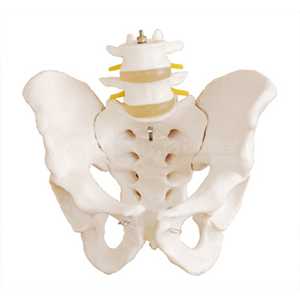
The BIX-A1020 is a life-size, hard vertebral column with pelvis, occipital bone and half-leg bones, mounted on a 34-inch iron seat. It shows nerve roots, vertebral arteries, intervertebral discs and transverse processes, and the page price is US $55.98. It is a demonstration model for chiropractic, orthopaedic and anatomy teaching — not a dissectable specimen and not a palpation trainer with soft tissue.
Quick answer. Buy the A1020 if you need one durable spine that a whole class can read from three metres away and that survives being wheeled between rooms. Do not buy it if your course assesses soft-tissue palpation, segmental joint play or needle placement: the A1020 has no skin, no muscle layer and no replaceable insert.
| Item | Specification | Teaching consequence |
|---|---|---|
| Model | BIX-A1020 vertebral column with pelvis and half legs | One unit covers cervical to sacral level plus hip orientation |
| Column height | 29 in (about 74 cm), hard spine | Readable from the back row without a projector |
| Additional structures | Occipital bone, humerus heads, vertebral artery, nerve roots, lumbar discs | Explains headaches, brachial and lumbar Referred patterns in one object |
| Base | 34 in high-grade iron seat | Free-standing; does not need a clamp or wall mount |
| Material | Hard synthetic column on metal stand | Wipes clean; no soft-tissue replacement cost |
| Reference price | US $55.98 | A departmental spare is affordable at this price point |
The A1020 is built around the relationship between the vertebral canal, the exiting nerve root and the vertebral artery. The column carries the occipital bone at the top, so a tutor can trace a continuous line from the foramen magnum to the sacrum in one movement.
The half-leg bones and pelvis matter more than they look. Most first-year errors in spinal palpation come from losing the pelvic reference: students count vertebrae upward from an iliac crest they have mis-identified. With the pelvis fixed to the column, the A1020 forces the student to locate the sacral base before counting.
The model also carries the lumbar discs and the transverse processes. That combination lets an instructor explain why a posterolateral disc herniation compresses a root that has already exited below its own disc level — a point that flat diagrams regularly get wrong.
Email adaanatomy@adaanatomy.com with your student numbers and bench height, and ask for the seat-coating and spare-parts sheet before you raise the purchase order.
One A1020 supports this loop for a class of 24 in four rotations of six students, with 20 minutes per rotation.
| Field | Value on the product page |
|---|---|
| Product number | BIX-A1020 / A1020 |
| Category | Pelvis models |
| Column height | 29 in (74 cm) |
| Base height | 34 in (86 cm) |
| Reference price | US $55.98 |
| Certification | ISO 9001, ISO 14001, ISO 45001 factory certification |
Q1. Is the A1020 life-size? Yes. It is described as a natural large spine model at life size, with a 29-inch column and a 34-inch stand.
Q2. Can students practise palpation on it? Only bony landmark identification. There is no soft tissue, so muscle tone, tenderness and tissue texture cannot be assessed.
Q3. Does it include the pelvis and legs? Yes. The model includes the pelvis and half-leg bones, plus the occipital bone and humerus heads.
Q4. What is the reference price? US $55.98 per unit before freight. Confirm the current price and any volume discount with the supplier.
Q5. Is it suitable for chiropractic teaching? The product page names chiropractic and orthopaedic professions as target users, because it exposes nerve roots, discs and the vertebral artery together.
Q6. How is it shipped? It is a rigid column on a fixed iron seat, so it ships as a single bulky carton. Ask for carton dimensions, gross weight and whether the seat can be detached for freight.
Contact. For seat-height options, spare disc inserts or a departmental quotation, email adaanatomy@adaanatomy.com. Product page: https://www.adaanatomy.com/pelvis-model/life-size-vertebral-column-with-pelvis-and-half-leg-bones-model-A1020 · Pelvis and spine models: https://www.adaanatomy.com/pelvis-model · All articles: https://www.adaanatomy.com/neslist.html
