ADA MED SUPPLY LIMITED
Phone:+86 13383897707
Tel:+86-0379-65160607
Email:adaanatomy@adaanatomy.com

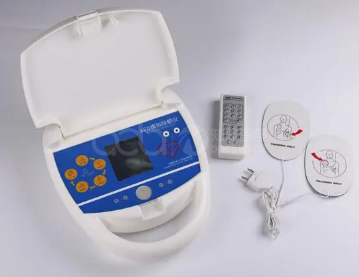
An AED trainer rehearses a sequence; it does not deliver a shock. The BIX/AED98 is a training device with ten programmed defibrillation scenarios, intelligent pad detection and prompts modelled on a real automated external defibrillator. It is the right tool for teaching recognition, pad placement and the pause before a shock. It is the wrong tool for energy selection, rhythm interpretation or post-shock care.
| Item | Detail |
|---|---|
| Model | BIX/AED98 |
| Type | AED training device (defibrillator simulator) |
| Scenarios | 10 defibrillation training modes |
| Feedback | Intelligent pad detection; real-device style voice and screen prompts |
| Reference price | USD 294.58, subject to order quantity |
| Certification | ISO 9001, ISO 14001, ISO 45001 |
| Best use | Lay responder, first-aid, nursing and clinical skills courses |
| Criterion | AED trainer (BIX/AED98) | Real AED in training mode | Online AED module |
|---|---|---|---|
| Shock delivered | None — safe in any room | None if pads are on a manikin | None |
| Pad placement feedback | Intelligent detection | Device-dependent | None |
| Scenario variety | 10 programmed scenarios | Device-dependent | Fixed video |
| Hands-on time per learner | High | Limited by device access | Zero |
| Cost per station | Low | High | Very low |
| What it certifies | Sequence and pad placement | Sequence on one device | Knowledge only |
An online module can teach the order of steps. It cannot teach the two things that fail under stress: where the pads go on a real chest, and whether the rescuer pauses long enough for analysis without losing the rhythm.
Most AED failures in training are not knowledge failures. They are placement and sequence failures: pads over the sternum instead of anterolateral, pads on a wet chest, or hands still on the patient during analysis. A trainer that detects pad position lets the instructor correct in the moment rather than afterwards, which is the difference between a demonstration and a drill.
Outcomes depend on time to first shock and on the proportion of the arrest spent in compressions [1][2]. That is why the drill should be timed: power-to-pads, pads-to-analysis, analysis-to-shock, shock-to-compressions. A stopwatch turns a familiar routine into a measurable one.
| Minutes | Step | What the learner does |
|---|---|---|
| 0–3 | Orient | Names the four steps: power on, attach pads, clear, follow prompts |
| 3–10 | Pad placement | Three rounds on the manikin, the second round with eyes closed |
| 10–18 | Scenario 1 | Witnessed arrest, shock advised; every step timed |
| 18–25 | Scenario 2 | Non-shockable rhythm or misplaced pads; learner recovers without prompting |
| 25–30 | Debrief | One thing done well, one to change, one time to beat |
The debrief is not optional. Simulation without structured feedback produces familiarity without competence [3].
For a quotation on the BIX/AED98, a mixed order with CPR manikins, or the current scenario list, write to adaanatomy@adaanatomy.com with your course volume.
Q1. Does the BIX/AED98 deliver a real shock? No. It simulates analysis, prompts and shock delivery for scenario practice only.
Q2. How many scenarios does it include? Ten defibrillation training modes, each modelling a different AED scenario.
Q3. What is intelligent pad detection? The device recognises whether the training pads are placed correctly, so a misplaced pad produces a correction instead of a false pass.
Q4. Can it be used with any CPR manikin? It is used alongside a manikin; confirm pad compatibility with the manikin surface you already own.
Q5. Is it suitable for healthcare professionals? Yes for the AED component of BLS and first-aid courses. Advanced life support needs additional equipment.
Q6. What does it cost? The listed reference price is USD 294.58, subject to order quantity. Request a formal quotation at adaanatomy@adaanatomy.com.
For pricing, the scenario list, or a quotation covering AED trainers plus CPR manikins for a full first-aid course, write to adaanatomy@adaanatomy.com with the number of stations you plan to run.
