ADA MED SUPPLY LIMITED
Phone:+86 13383897707
Tel:+86-0379-65160607
Email:adaanatomy@adaanatomy.com


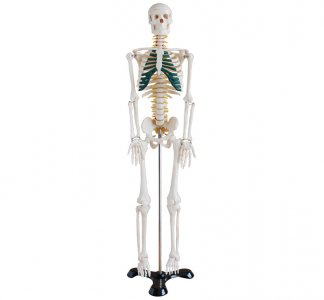
A full-size skeleton is a reference instrument, not a classroom decoration. The XX-A101N is a 170 cm life-size skeleton with muscle origins and insertions painted on the bone and numbered landmarks for self-testing. It earns its space when students need to judge real proportions; a 45 cm or 85 cm model earns its space when they need repetition, portability and storage. Most labs need both, in different ratios.
| Item | Detail |
|---|---|
| Model | XX-A101N |
| Type | Life-size human skeleton with muscle origins and insertions |
| Height | 170 cm |
| Markings | Painted muscle attachment areas; numbered landmarks |
| Mount | Display stand included |
| Material | Anatomical polymer (confirm on datasheet) |
| Price | Inquiry for best offer |
| Certification | ISO 9001 / 14001 / 45001 documentation on request |
True spatial scale. Students can stand next to the model and see where the iliac crest sits relative to the elbow, or how far the scapula extends down the thorax. Compact models preserve topology but lose this body-scale judgement, and body-scale judgement is what clinical palpation depends on.
Muscle markings in place. Painted origins and insertions turn the skeleton into a map of function. A student can trace the deltoid from clavicle and scapular spine to the deltoid tuberosity without switching between an atlas and a model.
Numbered self-testing. Numbers let a student cover the key and quiz themselves, or let an instructor run a spotter exam without labels. That is a different use from a painted-only model: the number is a prompt, not the answer.
A stable teaching reference. One full-size unit per lab becomes the anchor for every anatomy practical, from surface anatomy to radiograph interpretation.
Compact skeletons are not lesser models; they solve different problems.
The practical answer for most programmes is a mixed kit: one or two full-size numbered skeletons as references, plus a set of minis for repetition.
The question is not which model is better; it is which model supports the learning task in front of you.
Physical models have a measured advantage for spatial anatomy: a controlled study found that a physical model outperformed both 3D computer models and textbooks for learning imaging anatomy [2]. Reviews of anatomy education make the same point in curriculum terms — models should be selected for the spatial task they support, not treated as interchangeable illustrations [1]. Deliberate practice research adds the second half of the argument: repeated, feedback-rich practice is what converts a demonstration into skill [3].
That maps cleanly onto a purchase decision. Buy the 170 cm XX-A101N for reference and assessment; buy compact models for repetition. If the budget allows only one, choose based on whether your bottleneck is spatial understanding (full-size) or hands-on repetition (multiple compacts).
Q1. Is the skeleton exactly 170 cm? Yes, the product page specifies 170 cm with muscle origins and insertions and numbering.
Q2. Are the numbers on the bones or on a separate chart? The model is numbered; ask for the matching printed legend with your quotation so the numbering can be used for self-testing.
Q3. What is the price and minimum order? Price is quoted per order and depends on quantity and destination. Email adaanatomy@adaanatomy.com for a current quotation.
Q4. Can we order a spare stand or dust cover? Yes; specify them with the order so they ship in the same consignment.
Q5. How is it packed for export? A full-size skeleton ships in a long carton. Ask for carton dimensions and gross weight with the quotation to plan delivery and storage.
Q6. What certification is available? ISO 9001, 14001 and 45001 documentation is available on request; CE documentation can be quoted for EU procurement.
For the numbering legend, stand dimensions or a quotation: adaanatomy@adaanatomy.com. Production follows ISO 45001 management practice; CE documentation is available for EU procurement.
