ADA MED SUPPLY LIMITED
Phone:+86 13383897707
Tel:+86-0379-65160607
Email:adaanatomy@adaanatomy.com

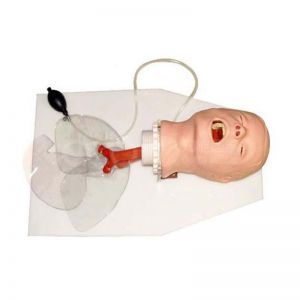

An intubation head earns its place by reproducing three things: a mouth that accepts a laryngoscope, an airway that resists the tube realistically, and a neck soft enough to practise cricoid pressure. The BIX-J50 covers all three, at a listed price of US$441.88, which puts it in the range where a department buys two rather than one.
| Item | Detail |
|---|---|
| Model | BIX-J50 |
| Category | Emergency models / airway management |
| Anatomy | Full-sized mouth, tongue, airway, oesophagus |
| Procedures | Oral and nasal intubation, oral and nasal suction |
| Special features | Respiratory sound auscultation; soft neck with cricoid cartilage for Sellick maneuver |
| Listed price | US$441.88 |
| Certification | ISO 9001 / 14001 / 45001 and CE documentation on request |
Airway skill is hand skill. A head-only trainer puts the trainee at the correct working distance and forces them to manage the laryngoscope with the left hand while the right hand controls the tube — the same economy of movement required at the bedside. Full-body manikins are useful for team scenarios, but they add positioning steps that dilute repetition in a short drill.
Deliberate practice research is clear that repetition with specific feedback, not volume of exposure, drives skill acquisition [1]. A head-only unit lets you run six to eight tube passes per trainee in 25 minutes, which is the repetition count that matters.
1. Oral intubation. The mouth, tongue and airway are anatomically proportioned, so blade placement and tube direction are practised against the structures that actually obstruct a view. Trainees should verbalise the grade of view they see before passing the tube.
2. Nasal intubation. Nasal passage and pharyngeal route are included. This is the station most often skipped in short courses, and the one where blind technique fails fastest without practice.
3. Suction. Oral and nasal suction let you teach the sequence that follows a failed or soiled airway — pre-oxygenate, suction, re-attempt.
4. Cricoid pressure. The soft neck with cricoid cartilage allows the classic Sellick maneuver, which improves the view of the vocal cords during rapid sequence induction. Difficult Airway Society guidance continues to treat cricoid pressure as a manoeuvre that must be applied correctly, with release if the view worsens [2] — a point best taught by feel, on a neck that responds.
The head includes respiratory sound auscultation. Use it to teach confirmation properly: five-point auscultation, observation of chest rise, and the discipline of not trusting a single sign. Trainees who learn confirmation on a model that can simulate an oesophageal placement are far less likely to accept a wrong tube in practice.
The stakes are documented. The Fourth National Audit Project of the Royal College of Anaesthetists and the Difficult Airway Society (NAP4) found that a large share of major airway complications involved problems with technique or judgement at intubation rather than equipment failure [3]. That is the argument for drilling the pass itself — blade placement, cuff check, confirmation — until it is a routine rather than a decision.
Q1. Is the BIX-J50 a full-body manikin? No — it is an intubation head, designed for airway procedures only. Team scenarios need a full-body simulator.
Q2. Does it support cricoid pressure? Yes. The neck is soft and includes cricoid cartilage, allowing the Sellick maneuver to be practised with an assistant.
Q3. Can trainees practise nasal intubation? Yes, both oral and nasal routes are supported, along with oral and nasal suction.
Q4. What is the price and minimum order? The listed price is US$441.88; MOQ is flexible. Email for the current price list and volume tiers.
Q5. What consumables are needed? Airway lubricant and replacement airway inserts are the usual wear items. Ask for a cost-per-100-intubations estimate with the quotation.
Q6. How do we order or request a sample? Email adaanatomy@adaanatomy.com with quantity, city and course type for the price list, carton data and lead time.
For the specification sheet, airway insert pricing and a department quotation: adaanatomy@adaanatomy.com. Production follows ISO 45001 management practice; CE documentation is available for EU procurement.
