ADA MED SUPPLY LIMITED
Phone:+86 13383897707
Tel:+86-0379-65160607
Email:adaanatomy@adaanatomy.com


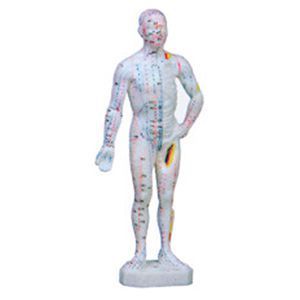
Short answer: BIX-Y1011 is a 26 cm PVC acupuncture model marked with 361 meridian points and 48 extra points. The left side is labelled in English and the right side in Chinese, and the model sits on a display base. At its published reference price of US $8.84, it is a desk-level point-location aid for beginners — not a full-size clinical training manikin.
Key takeaways
| Item | Detail |
|---|---|
| Model | BIX-Y1011 |
| Type | Body acupuncture model |
| Height | 26 cm |
| Material | PVC, placed inside a base |
| Points marked | 361 meridian points and 48 extra points |
| Labelling | English on the left (e.g., HN3, ST17); Chinese on the right |
| Reference price | US $8.84, subject to order quantity |
| Package size / weight | Not published on the product page |
| Teaching task | How the model supports it |
|---|---|
| First-pass point recognition | Students see the meridian lines and the point codes together, so the name and the location are learned as one unit. |
| Bilingual terminology | English codes on one side and Chinese on the other let a class compare the two naming systems without a second model. |
| Home study and revision | The 26 cm size is portable; a student can revise point locations away from the lab. |
| Classroom demonstration | The base holds the model upright for a table-top demonstration. |
| Point-count checks | 361 meridian points plus 48 extra points give a fixed reference set for quizzes. |
The model cannot teach needle insertion. It has no simulated tissue layers, no depth feedback and no response to needling. It also cannot teach true-scale surface measurement: at 26 cm, the distance between two points is scaled down, so a measurement learned on the model does not transfer one-to-one to a patient. Finally, the page does not state whether the printed points are individually numbered or only coded by meridian; that matters if your assessment asks students to name points in sequence.
These are not defects. They are the boundaries of a low-cost point-location aid. The mistake is to buy one model and expect it to replace a needling trainer, a full-size manikin and supervised practice.
Acupuncture education has been moving toward competency-based structures, and a 2025 review describes the shift in how acupuncture is taught and assessed [1]. A competency-based programme in Korean Medicine education reports the design and implementation of a structured training pathway [2]. A 2026 commentary argues that anatomy-based mapping of acupoints still faces conceptual challenges — exactly the gap a physical model is meant to narrow, but cannot close on its own [3].
In practice, the model works best as one layer in a sequence: lecture, physical model, needling trainer, supervised clinical practice. It is inexpensive enough to give every student a reference object, which is a different value proposition from a high-fidelity simulator.
| Not published | Why it matters |
|---|---|
| Carton size, quantity per carton and gross weight | Needed for freight and for a class-set order. |
| Whether points are individually numbered | Affects quiz design and self-study. |
| Whether a printed point index or manual is included | The page mentions an English user manual but does not describe its contents. |
| Price at your quantity | US $8.84 is a reference price, not a binding quote. |
Send those four questions to adaanatomy@adaanatomy.com with the model number BIX-Y1011 and your student count. We will confirm each point and attach the carton data.
Q1. How many points are marked on BIX-Y1011?
The page states 361 meridian points and 48 extra points.
Q2. Is the model life-size?
No. It is 26 cm tall. It is a desktop teaching model, not a life-size manikin.
Q3. What material is it made from?
PVC, placed inside a base.
Q4. Are the labels in English or Chinese?
Both. The left side is labelled in English (for example HN3 and ST17) and the right side in Chinese.
Q5. Can I practise needling on it?
No. The page describes a printed point model; it does not state needling depth, tissue layers or feedback.
Q6. What is the price?
The published reference price is US $8.84, subject to order quantity. Email adaanatomy@adaanatomy.com for a quotation at your volume and for the carton data.
Write to adaanatomy@adaanatomy.com with the model (BIX-Y1011), the number of students and the city of delivery. If you also need a life-size model for proportional measurement, say so in the same message so the two sizes ship together and the labelling conventions match.
