ADA MED SUPPLY LIMITED
Phone:+86 13383897707
Tel:+86-0379-65160607
Email:adaanatomy@adaanatomy.com


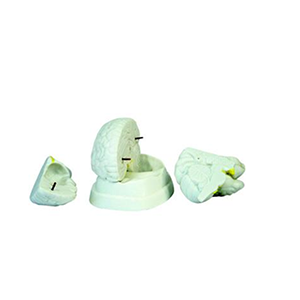
Short answer: ADA-304 is a life-size human brain model that separates into three parts and sits on a stand. The supplier states its purpose precisely: it demonstrates the external features of the brain as a whole, and the relations between the component portions. It measures 18.4 x 14 x 13.5 cm and is listed at a reference price of USD 20.04, subject to order quantity. Three parts is a deliberate design point, not a limitation — and the rest of this article explains why.
Key takeaways
| Item | Published value |
|---|---|
| Product model | ADA-304 |
| Description | Brain Model 3 Parts — Life-Size Human Brain Anatomy Model |
| Stated purpose | Demonstrates external features of the human brain as a whole and the relations between the component portions |
| Dissection | Into 3 parts |
| Size | 18.4 x 14 x 13.5 cm |
| Mounting | On stand |
| Reference price | USD 20.04 (subject to order quantity) |
| Certification shown | ISO 9001, ISO 14001, ISO 45001 |
For written confirmation of the material, unit weight and lead time, write to adaanatomy@adaanatomy.com quoting the model number ADA-304 and your order quantity — none of these three items is published on the product page.
The same catalogue lists a 3-part brain (ADA-304), a 9-part brain (ADA-304B) and a skull with an 8-part brain (ADA-135E). Buyers often read the higher number as "better". It is not — the part count sets the level of the course.
| Question a student must answer | Model that fits |
|---|---|
| What are the main divisions of the brain and how do they relate? | A 3-part model such as ADA-304. |
| Where does each lobe sit and how do the hemispheres separate? | A 9-part model such as ADA-304B. |
| How does the brain sit inside the skull and relate to the cervical spine and arteries? | A skull-and-brain combination such as ADA-135E. |
Put another way: buying a 9-part model for a first-semester class means half the pieces stay in the box, and each of them is a part that can be lost or broken. Matching part count to the syllabus is the cheapest form of durability planning.
The case for a bench model is not aesthetic. A meta-analysis of comparative studies concluded that physical models are effective in teaching anatomy [2], and the systematic review of advances in anatomy education describes virtual tables, immersive techniques and 3D printing as additions to — not replacements for — physical material [1]. For a three-piece brain at this price point, the strongest evidence-based argument is simple: every student can handle it, and repeated handling is what the meta-analytic effect depends on.
Q1. How many parts does ADA-304 separate into?
Three, per the product page.
Q2. Is it life-size?
Yes — the page titles it a "Life-Size Human Brain Anatomy Model" and gives its size as 18.4 x 14 x 13.5 cm.
Q3. What is it designed to show?
The external features of the brain as a whole, and the relations between the component portions.
Q4. What does it cost?
The page lists a reference price of USD 20.04, subject to the quantity of the order.
Q5. Is it supplied on a stand?
Yes, the page states "on stand".
Q6. How do I confirm material, weight and lead time?
These are not published. Email adaanatomy@adaanatomy.com with the model (ADA-304) and your quantity, and ask for the material, unit weight and delivery schedule in the same message.
Write to adaanatomy@adaanatomy.com for the ADA-304 specification sheet and a quotation. If you are equipping a neuroanatomy bench, ask in the same enquiry about the 9-part and skull-mounted versions — ordering them together keeps the labelling convention and the stand design consistent across the set.
