ADA MED SUPPLY LIMITED
Phone:+86 13383897707
Tel:+86-0379-65160607
Email:sophia@adahealthy.com


Article tag: Whole body loose bone model BIX-A1007 human bone model
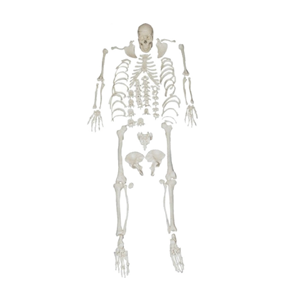
The application of whole body scattered bone model in medical education, especially in anatomy teaching, is gradually attracting wide attention. With the continuous innovation of medical education, especially in the field of anatomy teaching, the traditional cadaver anatomy is gradually transformed into a more flexible and safe simulation model, and the whole body scattered bone model may become the future trend of anatomy teaching.

Educational significance
The whole body scattered bone model provides an efficient and intuitive learning tool for medical education. Compared to traditional autopsy, the model can not only be reused, but also avoid the shortage of cadaver resources or ethical issues. It can help students to understand the anatomy of the human body in a more flexible environment, and strengthen students' grasp of the interrelationship between the various systems of the human body through hierarchical analysis and review. The model can reflect the structure of the real human body, so that students can operate repeatedly to improve the learning effect.
Learning experience for medical students
One of the challenges medical students face in the study of anatomy is how to maximize understanding and mastery of anatomical structures in the limited time available for autopsy. The whole body scattered bone model enables students to review and practice anytime and anywhere, enhance the memory of complex structures, and effectively improve their spatial understanding ability. The model provides students with a low-stress learning environment that eliminates the tension that may arise during autopsies and encourages them to be more active and engaged in learning.
Advantage of teaching model
The whole body loose bone model has a high degree of reducibility, and adopts modern high-quality materials, which can simulate the real anatomy of the human body, including multi-level tissues such as bone, muscle and blood vessels. This allows students to delve into the intricacies and details of anatomy. Compared with traditional autopsy, model training is not only more economical and environmentally friendly, but also helps students perform repeated operations at different angles and positions, promoting deeper learning.
Data support
Studies have shown that the whole body scattered bone model has a significant impact on the learning of medical students. According to a survey of 200 medical students, students who used the loose bone model to teach anatomy improved their knowledge and skill proficiency by about 30 percent. After the simulation training, these students significantly improved their anatomy test scores, and had a deeper understanding of the human anatomy structure, showing higher learning efficiency and stronger hands-on ability than traditional autopsy methods.
Conclusion
The application of whole body scattered bone model in medical education, especially in anatomy teaching, has great potential and advantage. It can not only help students better master complex anatomical knowledge, but also provide a more flexible, safe and efficient learning platform. With the change of teaching needs and the advancement of technology, the whole body loose bone model is expected to become the future trend of anatomy teaching, providing a more innovative and practical solution for medical education.
